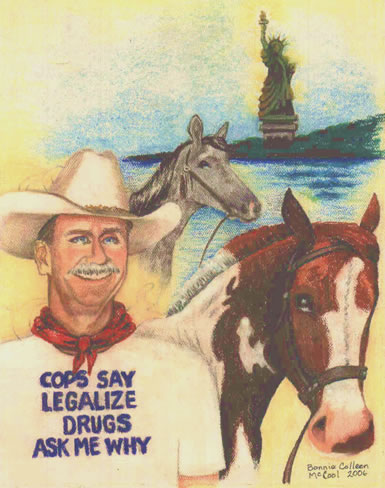
2006 Rebels with Just Cause Award

Here's a real cowboy hero, riding for freedom to save justice in America. Howard Wooldridge, from Ft. Worth originally, road his horses across the US. It took them three years to cross the county as a promotional event for LEAP. He has received an award from the Long Rider's Assoc. for his effort. He shares McCool's Rebel with Just Cause Award for 2006 with Cindy Sheehan. This award honors true patriots, those who stood for freedom and those still standing.
Back
in Saddle, Preaching Drug Legalization
By COREY KILGANNON
Published: October 5, 2005 NYTimes
The retired police officer warns, . . . . . . . . . . . . . . . "Drug prohibition causes more pain, suffering and death than the drugs themselves." Seeing the need to restore Justice, COP was founded to provide YOUR VOICE working daily in Washington, DC to repeal all drug prohibitions.

Your Voice in the United States Congress
COP's Stories from November 1st to January 31, 2013
Will lightning strike twice--Stockman/Democratic office: Earlier this year I had a planned meeting with an aide and when I arrived the legislative director and another aide sat in. The meeting lasted nearly an hour (20-25 minutes is normal). Later, the freshman from Texas became a co-sponsor of the bill to repeal federal marijuana prohibition.
This week roughly the same thing happened. The LD was candid that the Member has been against any changes for decades. He promised to bring up the repeal and try to persuade her to see the positive outcomes. Stay tuned.
Evacuation Drill = Perfect: These drills are always done when the Congress is in recess. Luckily I was able to finish my 1000 meeting, as the bell went off. Outside were three groups of high school kids and eventually someone from all three asked me why (I put my COP jacket on naturally). Meanwhile a documentary film maker was following me for the day and got it all on film. The footage cannot be posted to YouTube till next year but it was a rewarding moment on the Hill.
Whistle Stop Campaign: On the train home there were 30 senior high school students returning from a day in DC field trip. When I put my jacket on in preparation to get off at the next stop, the teacher asked why. In the next 9 minutes I had my jacket photographed 30 times and answered many questions. It was a super way to end an excellent day.
I am thrilled with this: I believe it will be a small to medium game-changer. The NAACP national has never endorsed this type of language.
Neill Franklin of LEAP and I worked on this together. I wrote the draft letter to the NAACP, asking for their endorsement. Neill did all the rest, carrying the ball for a touchdown. NAACP ENDORSES HR 1523 - ‘‘Respect State Marijuana Laws Act of 2013’’. (Continue)
James Madison, the primary author of the Constitution
of the United States, said this: "We have staked the whole future of
all our political constitutions upon the capacity of each of ourselves to
govern ourselves according to the moral principles of the Ten Commandments."
"In the end, however, no constitution can be self enforcing....For the
Constitution will live only if it is alive in the hearts and minds of the
American people." Roger Pilon, senior fellow and director of CATO's Center
for Constitutional Studies.
The Cato Institute offers copies of its
popular Constitution booklet. Phone Order: 1-800-767-1241


View Comments

SWISS HEROIN-ASSISTED TREATMENT 1994- 2008: SUMMARY
Overview: Due to the severe drug problem in Switzerland in the early 1990s, (rising number of injection drug users, visibility of open drug scenes, AIDS epidemic, rising number of drug related deaths, poor physical health, high criminality) the Swiss made a fundamental shift in approaching the problems caused by heroin addiction. The Swiss offer treatment-on-demand. Of an estimated 22,000 addicts, 16,500 are in treatment and 92% are given daily doses of methadone at conventional clinics. The Swiss treat about 1300 addicts with maintenance doses of heroin via 23 special clinics operating in cities and two prisons. The Swiss approach has resulted in lower rates of crime, death, disease, a drop in expected new users as well as an improvement in mental and physical health, employment and housing. The program has been copied by six countries: Germany, Holland, Belgium, England, Spain and Canada.
* To qualify for a heroin prescription: 1) at least 18 years old; 2) been addicted (daily use) for at least two years; 3) present signs of poor health; 4) two or more failed attempts of conventional treatment (methadone or other); 5) (Continue below)

by those who serve in the War on Drugs
 |
 |
 |
 |
 |
 |
 |
 |
 |
 |
 |

(SWISS HEROIN-ASSISTED TREATMENT continues)
Surrender drivers license; 6) Heroin can only be obtained at the clinic and must be consumed on site (oral or injection). (Note: Under strict control and specific criteria [for example full employment] a few are allowed to take one oral dose daily away)
Patients can receive up to three doses of
heroin per day. 60% take the heroin via needle injection, the rest via pill.
The use of the oral pill is increasing.
Patients average about three (3) years in this plan. However, they may stay
in treatment indefinitely. 20% of original patients are still in the program.
The vast majority of patients are satisfied or very satisfied with the program.
Average age of patient: 38 years.
*Crime Issues: 60% drop in felony crimes by patients. 82% drop in patients selling heroin.
*Death Rates: No one has died from a heroin overdose since the inception of the program. The heroin used is inspected for purity and strength by technicians.
*Disease Rates: New infections of Hepatitis and HIV have been reduced for patients in the program.
*New Use Rates: Lower than expected. 1) As reported in the Lancet June 3, 2006, the medicalisation of using heroin has tarnished the image of heroin and made it unattractive to young people. 2) Most new users are introduced to heroin by members of their social group and 50% of users also deal to support their habit. Therefore, with so many users/sellers in treatment, non-users have fewer opportunities to be exposed to heroin, especially in the rural areas.
*Cost Issues: 48 dollars/day: Patients pay from zero to 12 per day depending on their ability. Note: About 30% of patients work for a living and pay part of the costs. Note: The Swiss save about 30 dollars per day per patient mostly in lowered costs for court and police time, due to less crime committed by the patients.
** This summary was taken from five published reports. The Swiss Federal Office of Public Health reviewed and approved its release. Additional questions should be directed to Dr. Dora Fitzli, the science and health advisor to the Swiss Ambassador at the Embassy. Her English is near native fluency. Tel: 202-745-7954
NOTE: This summary was researched and written by Howard J. Wooldridge of LEAP.
Who Supports the Drug War?
Ossama Bin Laden, President George Bush, The Ochoa Brothers, Congressman Mark Souder, Mexican Drug Cartels, DEA, FARC, National Association of Narcotics Officers, Canadian Cannabis Growers Association, Pharmaceutical Industry, Al Qaeda, Private Prison Association, Meth Makers of Mexico Association, John Walters (USA’s Drug Czar), MS-13 drug gang, California Narcotic Officers’ Association, Crips & Bloods, Deputy Chief Thomas Gorman of California, Pablo Escobars’ Amigos, Congressman Duncan Hunter, Columbian Coca Growers Association, Senator John McCain et al, Fundamentalist Christian Association, The Washington Post, The New York Times, Newsweek, Time
See a pattern here? Ever wondered why it has been so difficult to make even small changes in our policy of prohibition AKA War on People? The 10 major organizations which are trying to end the New Prohibition have a total budget of about 25 million dollars. The drug companies which fear God’s medicine, AKA marijuana, put that much in the freezers of politicians to stifle competition. Does Al Qaeda contribute to the Republican Party? If opposition to the Drug War continues to grow, Al Qaeda would be advised to funnel cash to prohibition politicians. Prohibition puts 3 billion in OBL’s hands every year. Putting 100,000 into a freezer is chump change compared to losing billions.
The California Narcotic Officers Association fears the loss of their paychecks, knowing that the sensible People of California would legalize, regulate and tax marijuana the day after the feds end the National Prohibition. Even if they did not lose their paychecks, they would be reassigned to go after drunk drivers, child predators and other public safety threats. That type of work is boring compared to kicking in a few doors a week, waving their guns around and arresting people. Heaven forbid they would have to take a stolen bicycle report!
MS-13 gang makes billions selling illegal drugs in the USA. They would not be happy to see the end of Prohibition. They would have to go back to landscape jobs! President Bush supports the Drug War to keep his Pharma Industry lobbyists happy. He views the weekly deaths of young teens who die selling these drugs on the sidewalk as ‘God’s Will.’ So no problem there. Mexican drug cartels enjoy the finest tequila and tacos in Mexico on the money they are making. As a bonus, their narco-dollars buy them influence at the Presidential Palace in Mexico City. The private prisons in the USA lobby for more mandatory drug sentences in order to keep their cash flow coming. The Meth Makers of Mexico make billions exporting their product into the US and Canada.
Congressman Mark Souder supports the Drug War because he uses it to get re-elected. “I am getting tough on drugs!” He has convinced the voters in Indiana that the 2nd trillion dollars spent on this policy will result in drugs being slightly less available to their kids. Ditto Congressman Duncan Hunter who has convinced his California constituents of the same thing. Our Drug Czar John Walters simply likes his government job with all the perks of flying around the world saying how much progress was made this year. He reminds me of General Westmoreland during the Vietnam War and body counts.
The growers of BC Bud are making billions exporting to the US the most potent pot on the continent. That industry now employs more people in British Colombia than mining or forestry. The Crips and Bloods make billions as a vertical monopoly buying in bulk and employing their members for the retail sales. Experts say that the economy of several large cities would collapse without the cash that the dealers generate for their home neighborhoods. FARC (guerrillas of Colombia) have been making billions protecting the Coca Growers of Colombia Association. FARC uses their profits to wage war on the Bogotá government.
Fundamentalist Christians are adamant that God believes the Drug War is just and righteous and that Jesus would also support it. Right. Jesus would put a cocaine user in the hell hole of a Texas prison for two years. NOT. ‘But it is immoral to use these drugs’ they say with indignation. When confronted with the fact that young teens die every week because the policy employs a million teens, they usually blame the parents for the deaths, not their support for the policy. Native Americans have used mind-altering substances for centuries. Is the Christian religion superior to their beliefs to the point that Indians should go to jail? NOT! WWJD?
The Washington Post, the New York Times, Newsweek, Time and US News & World Report all support prohibition. Could it be they do not want to upset the drug makers who take out 3-4 full page ads for their drugs? Money talks.
As you can see, the supporters of Prohibition Two are numerous and well-funded. Nonetheless, I will use my one-eyed horse Misty and my Stetson to promote the end of the most dysfunctional, immoral policy since slavery until it is in the history books, or I draw my last breath.
written by Howard J. Wooldridge

If you have 47 minutes: go to PRESSTV.
Click on ‘Programs’ located on the left side of the homepage near the top.
Click on ‘American Dream’
Click on 21 February: Human Rights in the US
US Representative Barney Frank has reintroduced a bipartisan federal bill to legalize "small amounts" of marijuana (cannabis) and make room for serious criminals. Representative Ron Paul is a cosponsor. This Texas straight talker says we are "politicizing pain." "The Personal Use of Marijuana by Responsible Adults Act of 2009"- H.R. 2943.
“Medical Marijuana Patient Protection Act”- H.R. 2835 which would allow the medical use of marijuana in states that have chosen to make its use for medical purposes legal with a doctor's recommendation. The debate over medical marijuana or cannabis is really a scandalous controversy over whether this very safe, effective, easy-to-grow herb should be allowed to compete with expensive dangerous pharmaceuticals
Harassing the sick and dying is an un-American activity.
Commissioned Art - Paintings and Sketches
"Once upon a time you or someone you love was a shining star! Commission a painting or sketch to commemorate that occasion! You can rest assured, it will not be forgotten! "
Dear Colleen:
We are witnessing a truly pivotal moment in drug policy reform. In just a few short weeks, California voters will have the opportunity to vote for Proposition 19: The Regulate, Tax and Control Cannabis Act of 2010. Prop 19 will put police priorities back where they belong by allowing law enforcers to do their jobs more effectively, ending the arrest of nonviolent marijuana users and making the streets safer for everyone. Whether you are a resident of California or not, Prop 19 affects all of us. The passage of this initiative would be a major victory for the drug policy movement and will impact every state, laying the groundwork for future reform and serving as a model for legalized regulation.
LEAP’s speakers, particularly those based in California, have been hard at work to support Prop 19. On September 13, LEAP held a press conference, which received significant media coverage, to announce our endorsement of the initiative. Since then, our speakers have been in high demand in the national and local California press to discuss Prop 19 from a law enforcement perspective. LEAP has also partnered with the Just Say Now campaign calling on President (Continue)
To make a contribution to LEAP, please click here. Read on for more about what our speakers have been doing in support of Proposition 19…
Sincerely,
LEAP Staff
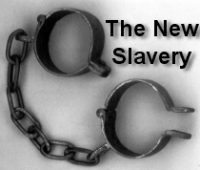
Please view “The New Slavery”a video created by
LEAP Administrative Director Bill Fried which makes a dramatic link between
slavery and the war on drugs. The video is featured on our website and on You Tube.
Neill Franklin, Kyle Kazan and Judge Jim Gray on CNN
Retired Maryland State Police Major and executive director of LEAP Neill Franklin, former Torrance, CA police officer Kyle Kazan, and retired Orange County Superior Court Judge James Gray appeared on CNN to discuss the urgent need for legalization and regulation.
Joseph McNamara and Norm Stamper on CBS Evening News and Fox News Channel
Former San Jose, California Police Chief Joseph McNamara and former Seattle Police Chief Norm Stamper – who spent 28 years of his law enforcement career with the San Diego Police Department – appeared on CBS Evening News in support of Proposition 19.
Chief McNamara also appeared on Fox News Channel’s Fox and Friends to talk about why it’s time to legalize marijuana.
Stephen Downing on MSNBC
Retired Los Angeles Police Department Deputy Chief Stephen Downing presents the case for legalization on MSNBC.please click here.
LEAP in the News in California
Retired Our speakers have been making waves in the local California media, and as election day approaches, LEAP's visibility continues to increase. Among the many news features on LEAP were Leo Laurence, a former deputy sheriff, recently featured on NBC News 11 as he spoke to students at Imperial Valley College in Imperial, CA, and former Sutter County, CA deputy sheriff Nate Bradley appearing on CBS 5 News.
To view more videos featuring LEAP speakers, please visit our YouTube channel at www.youtube.com/copssaylegalizedrugs
E-mail us at kristin.daley@leap.cc
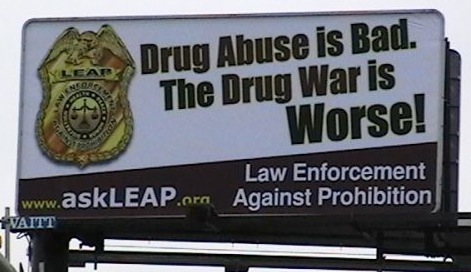
LEAP is a nonprofit educational organization
with Tax Exempt Status under United States tax code 501(c)3, Federal EIN:
16- 1645758.
AMAZING VIDEO EVERY PARENT SHOULD WATCH:
The ADHD Fraud: How Psychiatry Makes "Patients" of Normal Children Beware, psychiatrists earn more money from drug makers than doctors in any other specialty and there is a link between psychotropic drugs and violence including school violence!
COP ON THE HILL (continues)
Calvary Division: At Grover Norquist’s brunch I met a person who will be running for the US Senate in 14. Besides a few words on drug prohibition, I demonstrated the power of the horse to win the votes. I use the excuse of ‘horse power’ to introduce myself and my politics.
New Ally: I spent the week hand-delivering the NAACP endorsement of HR 1523 to all 535 offices in the Congress. I had brief chats with two dozen aides whose reactions ranged from “this is helpful” to “this is important” to “this is huge.” I was able to have 1-3 minute chats with a record five (5) Congressmen.
Congressman Cooper was headed out the door with his golf clubs and I asked if I could have 20 seconds. He nodded as he waited for the elevator. He is on our side and voted last year to cut-off DEA money to states with medical marijuana. He agreed to take a look at the NAACP endorsement upon his return.
NOTE: I spent all day Monday sending out an email of the endorsement to all offices. I wanted to make sure they had a copy. Moreover, by hand-delivering usually at least two more aides (in the reception area) knew of the event:
To an R office I would announce: (try doing this 200 times in a day)……… ‘I have cheerful news if your boss likes the 10th Amendment/States Rights. The NAACP has endorsed a 10th Amendment approach to pending legislation. So your boss has a new ally of the 10th. The issue is federal prohibition of marijuana. If your office doesn’t like the 10th, you have a new adversary.’ (my voice would have a hint of irony at this point)
To a D office: ‘ I have cheerful news if your office doesn’t like the war on drugs. The NAACP is your new ally. They have endorsed the bill to make marijuana a states’ rights issue. This is not an April Fool’s joke. Please give this to your chief legal counsel or the LA (legislative asst) who handles judiciary.
It took 3 days to hand-deliver a copy to 535 offices. My feet need medical marijuana, they do. Thus my being on vacation next week is good timing. I am pooped. (Continue)
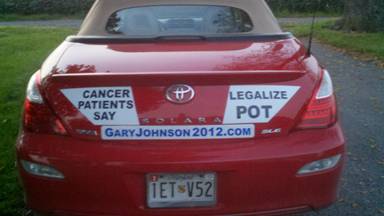
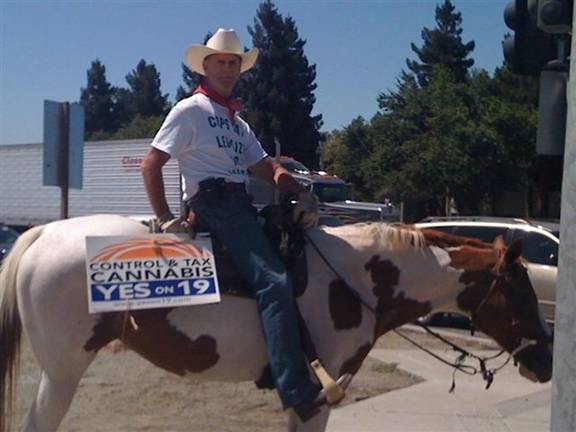
Very first day with signs in San Jose, CA
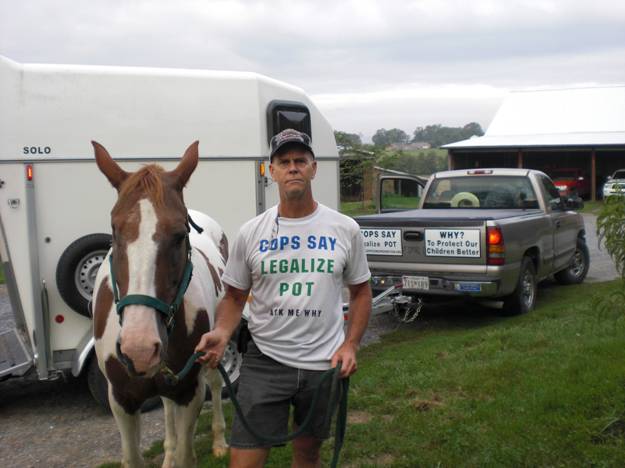
Leaving home: note new signs on back of pick up.
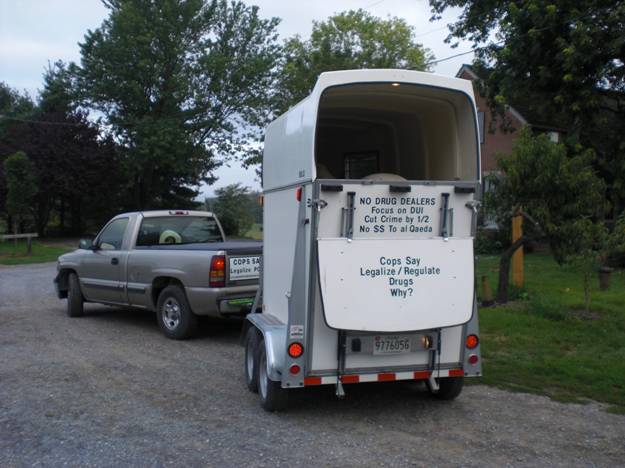
Leaving Maryland: the trailer generated a solid 100 honks and thumbs up across America
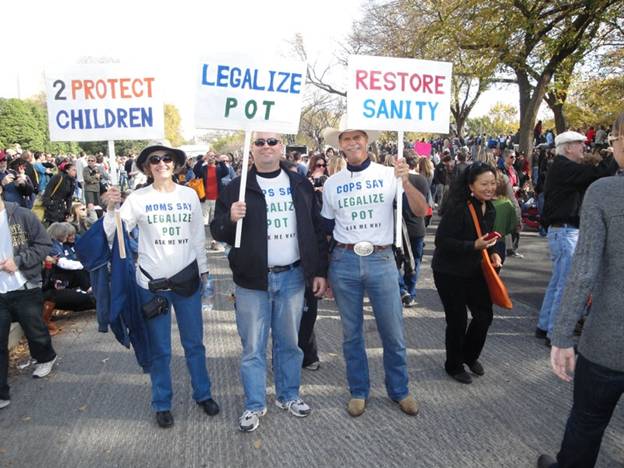
Restore Sanity Rally

Karen and I got away for a week to Puerto Rico.

The Insanity of Marijuana Prohibition in one foto!
COP ON THE HILL (continues)
Portugal at dinner: While in Denver at the DPA conference a gentleman from Portugal asked to sit at our table. Turns out, he was receiving an award. He was THE architect of the Portugal Decrim Program. I was able to have all my questions answered. Fascinating.
Getting the word out: I forgot to mention last week that besides making sure all in Congress knew of the NAACP endorsement of the bill to repeal federal marijuana prohibition, I sent an email to every journalist I had met in 17 years….some 150..
On the boat last week I had an average of 12 people a day ask me why. Since the ship sailed from Puerto Rico, a fair number of those were in Spanish. Leaving the ship, I was truly relaxed and refreshed. Answering the why question in an informal setting is a pure joy & not work.
I also encouraged all the islanders to be the first Caribbean nation to legalize marijuana. That island would become a Mecca for tourists, like Amsterdam. It was fun to see their reaction to my proposal.
Hereis a RARE Kurt Wallace report(conservative blog & radio) 4.5M report on COP efforts to spread the word on the NAACP endorsement…either read the transcript or listen to the radio interview… either way, your support for COP is making an impact.
Footnote: Thanksgiving week was spent trying to catch up on several hundred emails, etc.
Wishing you and yours and good Turkey Day. (Continue)
Lawman’s Blues
Few dare tell the truth about drugs
Salt Lake City Tribune editorial for May 13 2012
"You ask any DEA man, he’ll say, ‘There’s nothing we can do.’" — Glenn Frey, "Smuggler’s Blues"
Imagine a world where doctors were the only people who were not allowed to offer their opinions on medicine. Or where what farmers thought about agriculture was left unsaid for fear of public disapproval.
That, more or less, is the situation for law enforcement officers when it comes to any real conversation about how the United States deals with the problems associated with drug abuse. The ones who know from personal, and sometimes heart-breaking, experience just how futile the whole sad enterprise is are the ones who dare not speak out for fear of being seen as soft on crime.
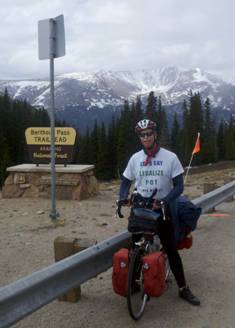
There are, luckily, exceptions. One of them rode through Salt Lake City the other day, on his bicycle and on a lonely mission to show the American people just how wrong we are to continue to insist on taking a law enforcement hammer to a public health nail.
Howard Wooldridge is a retired Michigan police officer and a co-founder of the national organization Law Enforcement Against Prohibition (www.leap.cc). As he explained to The Salt Lake Tribune the other day — and to many others along his ride from Oregon to Georgia — the problems we associate with drug use are not caused by users.
They are caused by the laws, law enforcement officers, judges and, mostly, craven politicians who dare not see or tell the truth about how the ongoing prohibition of drugs is nearly as destructive and just as futile as was the prohibition of alcohol early in the last century.
LEAP favors the legalization, regulation and taxation of now-illegal drugs, along the same model as alcohol and tobacco. That may be too drastic for our culture to embrace all in one go. But even moving toward a decriminalization approach, which stresses education and treatment over arrest and incarceration, would be a huge improvement.
Alcohol and tobacco, of course, create a long list of serious social and health problems. But heavily armed drug lords and the destruction of civil society in parts of Mexico, clogged courts and packed prisons in the United States and street violence of the kind that claimed the life of an Ogden police officer only a few months ago are not among them..
If we took the undeniably huge problem of drug abuse away from the police and gave it to the doctors, where it by all logic and humanity belongs, we could save billions in law enforcement costs, spend millions on treatment, and take a huge step toward real national sobriety.
COP ON THE HILL (continues)
Are you really a cowboy? I spent the better part of Wednesday at Grover Norquist’s meeting room. After the usual meeting, a new international group convened. This group of about 20 will meet once a month.
After the meeting I met the assistant to the group leader. Upon learning her first language was French I naturally began speaking her language. She was fascinated about the trip across America & I was telling her some stories, when another guy listened in for a moment. He then remarked that cowboys don’t usually speak fluent French, “so are you really a cowboy?” I smiled and whipped out my foto of Misty and me on the beach in Oregon at the end of our first coast to coast. “Yes sir. The cowboys in Texas gave me permission to call myself a cowboy, since I rode one horse 3100 miles.” Grover was listening in to the last part of the chat & smiled. Always a positive to make the host look good.
* I had a good chat after the first meeting with a gentleman who is running for the US Senate. All good.
* A member of the Republic National Committee taught me the Spanish word for ‘very drunk/shit-faced.’ Another former staffer for Bush 43 joined us in a chat in Spanish…Grover’s meetings continue to produce…………….
I also attended a seminar of the Federalist Society which brought in the asst. Attorney General from Colorado + 4 other prosecutors and lawyers. The topic was marijuana stores opening in 2014. All good.
Two whole days were spent contacting the 140 offices that need a presentation. I booked 16 for the next two weeks….the rest never write/call back..grrrr.
Morning Senator: I was waiting for my 10 o’clock meeting to start, when Senator Roy Blunt (R- MO) came up to me, shook my hand and asked, “What information are you giving my office today?” I was able to give my 90 second pitch, emphasizing that I represented law enforcement who are against prohibition, advocate that drug issues should be handled by the medical community and the whole policy should be guided by the 10th Amendment. That was a first chat ever with a Senator in his office. A double Crown Royal that night. Just showing up is 80% of success.
You like that?: A fellow Texan and I were chatting near the elevators in the Longworth House Office Bldg, when I noticed Congressman Labrador (R-ID) approaching with an aide. When he came within easy ear-shot, I said in a fairly loud voice to my Texas buddy,” Idaho will legalize marijuana in the next few years.” The two looked at me for a moment and then went back to their conversation.
The Texan asked what I was doing, since we had not been talking about marijuana. I told him I wanted to give the Congressman something to ponder. He responded I was crazy in a good way.
You never know: First let me say that currently there are rumors of about 5 Senators that might become candidates for President. That said, I met with two aides of one of those 5. This was a follow-up meeting, as we first met in 2012. We had an excellent 45 minute chat, both stating they were one with me on marijuana being a states’ rights issue.
Their bosses biggest concern was how to answer the scenario of the DUI on marijuana. I explained the detection, arrest, evidentiary and court room procedures to win a conviction. I then pulled out of my briefcase a one pager of what I had just said. They said they felt they had a handle on the ‘how to’ and would bring the idea of a companion bill (to HR 1523) to the boss and explain how to arrest, prosecute a DUIM. Who knows? If this seed bears fruit, you will hear my scream.
COP did its part in 2013 to move drug prohibition into the history books. Many hundreds of visits to Congressional offices combined with being a part of the effort to have the NAACP endorse the marijuana repeal bill (HR 1523) all meant more awareness of the problem and the federal solution. COP and its members can be justifiably proud of what was achieved.
As a professional I must contain and suppress any emotions, when dealing with the Congress and beyond. I read the same horror stories you did in 2013 of pain, suffering and death caused by drug prohibition. So how could I express myself to the Congress without going “over the line.” Tell me if you think I succeeded.
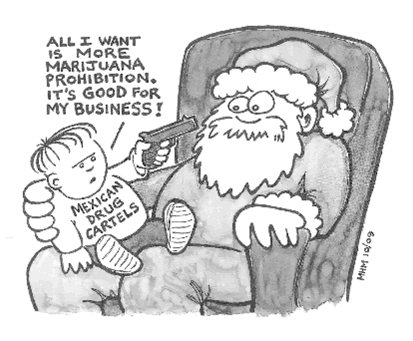
Evil Twin Brother: To deliver the Mexican Drug Cartel Association Christmas card – I had to go incognito. That meant jeans, baseball cap, tennis shoes, ordinary shirt and belt buckle. Only about 5-6 people recognized me. I explained they were thinking of my evil twin brother who wants to legalize drugs. ( think ‘City Slickers II’ the movie).
Here was my 45 second pitch to offices that I knew opposed COP goals:
‘Hi. I represent the Mexican Drug Cartel Association (said it little slow and loud). We want to thank Congressman Sensenbrenner for all his support in 2013 to keep marijuana illegal and hope he will do the same in 14. We agree that legalization would be a disaster, costing billions and billions.
Due to his voting record, the Cartels are going to make a generous contribution to his re-election campaign. We, The CARTELS, need more guys like your boss in Congress.’
When the aide said Merry Christmas, I replied “Igualmente.” {likewise to you}
***** As I was making my pitch, only about 20 aides realized – in the moment- that I was putting their boss shoulder to shoulder with the Cartel butchers…and I wish I could show you their faces….it went from all sunny and Christmas joy to ‘let the door hit you in the ass on the way out.’ It was precious. ….I have no doubts that w/in a minute of me leaving, the other 250 offices who heard the above realized what I had been saying.
Any office that had not taken an official position or was a supporter of ours I just said:
‘Hi. I represent the Mexican Drug Cartel Association. I bring Christmas greetings from the Cartels. We hope you will keep marijuana illegal. The card has some humor but you know we are serious. We ARE the Cartels.’
COP stats since inception: August 2009
46 chats with other elected officials, state reps, senators, VIPs, etc. 00 this week
35 Radio Interviews.. 00 this week (NPR Canada)
23 published interviews in major (daily)newspapers or magazine… 00 this
week
64 interviews and reports in minor media = blogs, cable TV, weekly papers,
etc.. 00 this week
46 brief chats with Members of Congress.. 00 this week
16 major conferences attended.. this week (CPAC, LULAC, NRA, CBC, ASA, DPA,
Dem & Repub. Presidential conventions. etc) this week
34 Appearances on major TV networks..this week(Fox, ABC, CBS, NBC, Univision)
72 published letters to the editor (value per MAPINC in free publicity: $70,000)
2 editorials in daily papers mentioning Howard’s efforts & in support
of COP position
Permanent invitation to Grover Norquist’s Wednesday brunch attended by
150 conservative leaders. Named the “Grand Central Station of the Conservative
Movement.”
Consider
being a member of COP at $30.00 or more per year. All contributions
are tax-deductible. Law Enforcement’s voice in opposition to current
policy is vital on the Hill to achieve a repeal of federal prohibition. COP
provides that voice. If you agree that Modern Prohibition/War on Drugs is
the most destructive, dysfunctional and immoral policy since slavery &
Jim Crow and want to be a part of the solution… Go to:
www.CitizensOpposingProhibition.org
and click on Donate/Join – by credit card or send a check to:
Citizens Opposing Prohibition POB 543 Buckeystown, MD 21717
If you have questions or comments, please send an email to: howard@citizensopposingprohibition.org
Here is a summary of the Holder memo!
Marijuana industry eager to pay taxes – and cash in on deductions
"As Congress wrestles with big budget cuts, marijuana businesses want to help out the federal government with a novel message: Tax us, please. Pot advocates say legalizing the drug and taxing it like alcohol would add billions to the federal treasury, McClatchy Newspapers report. Some analysts dismiss a pot tax bonanza as far-fetched. Still, the idea is stirring serious debate on Capitol Hill.
The Senate Finance Committee included marijuana taxes in an options paper on possible new revenue sources. In the House, one proposal would legalize pot, tax it, and regulate it nationally. The less ambitious Small Business Tax Equity Act would allow the Internal Revenue Service to give breaks on federal income taxes for marijuana businesses. Noting that pot remains a banned substance, Harvard economist Jeffrey Miron said, "If they don’t like the fact that they can’t take certain tax deductions because they’re in an illegal business, then they should go in some other business where they can take tax deductions."

As Election Day draws closer, Proposition 19 has a majority of support in the polls, but the vote will be close. If you are a resident of California, please VOTE, and remind everyone you know to vote. Today, October 18, is the deadline for voter registration in California.
LEAP is at the forefront of drug policy reform, and our speakers have a credibility that cannot be ignored. Your genorosity sustains our work.
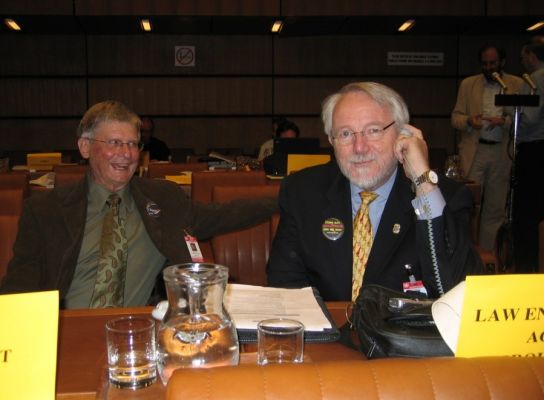
To view Jack Cole’s blog on the United Nations Conference in its entirety, including photos from the conference, please click here.


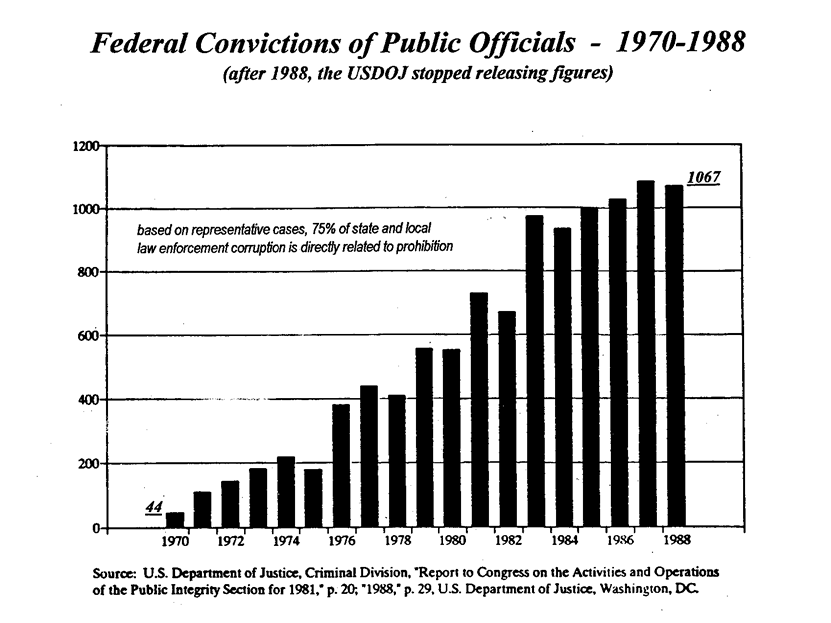
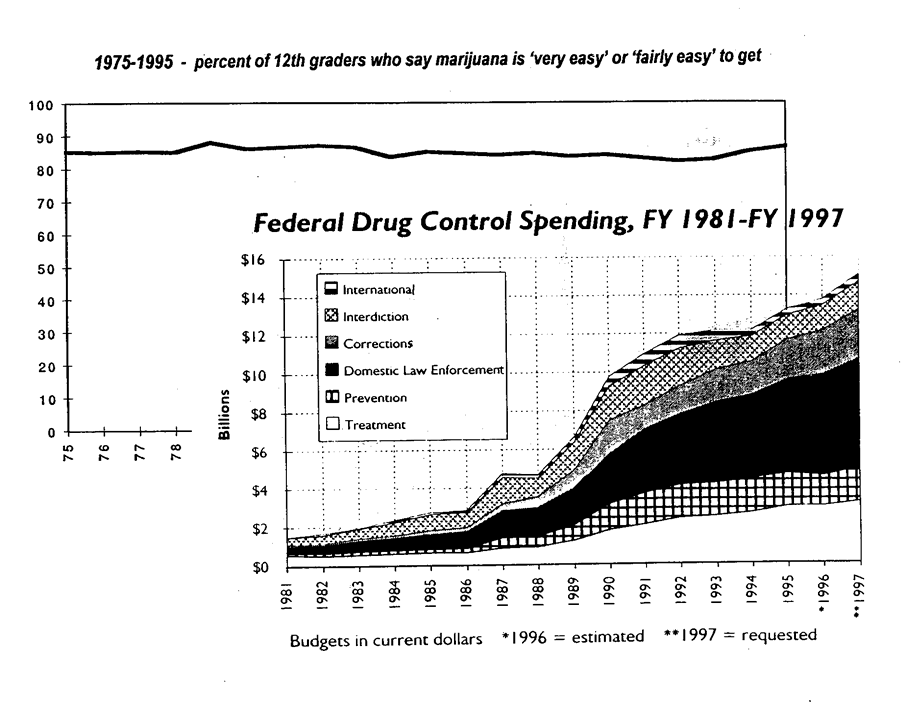
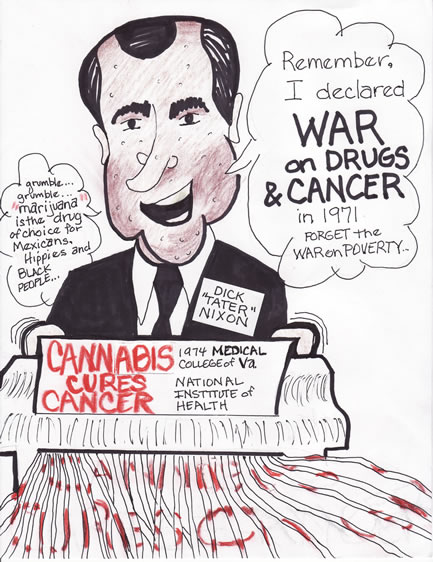
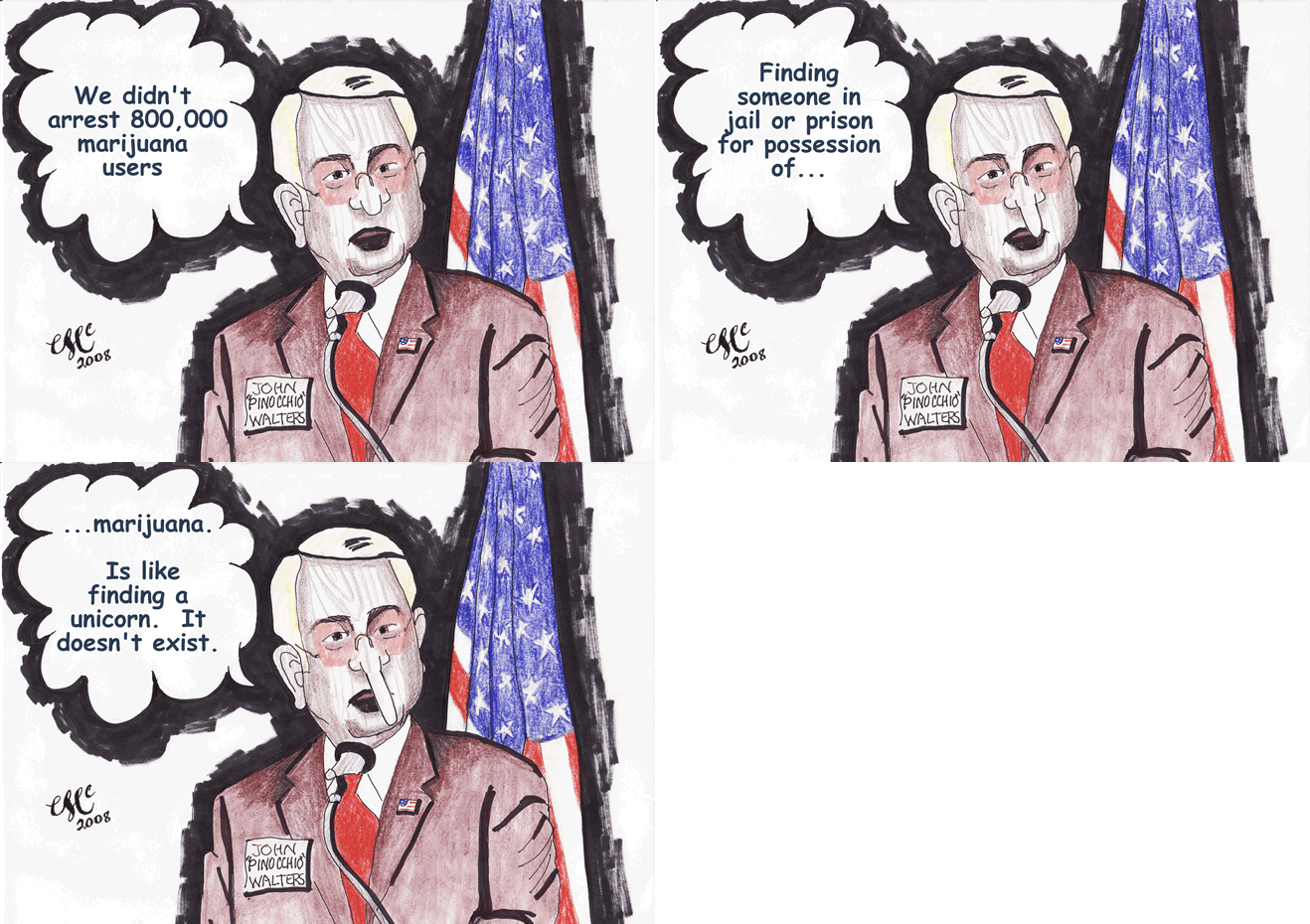
Ask the DOJ to release more current stats: askdoj@usdoj.gov
By Kathleen Parker
Friday, February 13, 2009
Drink and drive and it's grrrrrrrr-eat! Smoke pot and your flakes are frosted, dude. So seems the message from Kellogg's, which has decided not to renew its sponsorship contract with Michael Phelps after the Olympian was photographed smoking marijuana at a party in South Carolina.
That's showbiz, of course, but the cereal and munchie company had no problem signing Phelps despite an alcohol-related arrest. In 2004, Phelps was fined and sentenced to 18 months probation and community service after pleading guilty to driving while impaired. The silliness of our laws -- and the hypocrisy of our selective attitudes toward mood enhancers -- needs no further elaboration. Even so, things are getting sillier by the minute.
Sheriff Leon Lott in South Carolina's Richland County has now made eight pot-related arrests based on the snap that shot around the world. Seven were for possession and one for distribution, after deputies used warrants to enter the house where Phelps allegedly was photographed.
Phelps may be next.
In an earlier column, I gave Lott the benefit of the doubt, suggesting that his hands were tied given the laws of the land and South Carolina's political climate. I retract the benefit.
Sheriffs, though elected and therefore political, have great latitude as to what crimes they pursue. In a state that recently ranked among the most dangerous in the nation, one would think South Carolina's law enforcement officials have better things to do.
Indeed, they do. In our peculiar obsession to track down the Willie Nelsons, the Rush Limbaughs and now the Michael Phelpses of society -- nonviolent, victimless imbibers of drugs -- we've actually made society less safe. That's the conclusion of 10,000 cops, prosecutors, judges and others who make up the membership of Law Enforcement Against Prohibition.
Howard Wooldridge, LEAP's Washington representative, is a former cop and detective who lectures civic clubs and congressional staffers on the futility of drug laws that reduce public safety by wasting time and money. He points to child pornography as just one example.
As of last April, he says, law enforcement had identified 623,000 computers containing child pornography, including downloadable video of child rape. Only a fraction of those have been pursued with search warrants, thanks to limited resources and staff shortages. What's worse, Wooldridge says, is that three times out of five a search warrant also produces a child victim on the premises.
Another example: Last year, Human Rights Watch reported that as many as 400,000 rape kits containing evidence were sitting unopened in criminal labs and storage facilities. Between the Los Angeles Police Department and the L.A. County sheriff's office, nearly 12,000 kits were unopened, according to an NPR report in December.
Arguments against prohibition should be obvious. When you eliminate the victimless "crime" of drug use, you disempower the criminal element. Neutering drug gangs and cartels, not to mention the Taliban, would be no small byproduct of decriminalization. Not only would state regulation minimize toxic concoctions common on the black market, but also taxation would be a windfall in a hurting economy.
No one's saying that drugs aren't dangerous. Alcohol and tobacco are also dangerous.
And no one thinks children should have access to harmful substances, though they already do. Parents who recoil because their child became an addict should note that prohibition didn't help.
What prohibition did was criminalize what is essentially a health problem -- and overcrowd prisons. In 2007, there were 872,720 marijuana arrests in the United States. Of those, 775,137 were for possession. South Carolina just added eight to this year's roster.
The greatest obstacle to drug law reform is public fear and politics, says Wooldridge, as he set off to give eight presentations on Capitol Hill yesterday. "I've had staffers tell me that to even call a hearing will get you un-elected."
Which, perhaps, explains why Sen. Jim Webb (D-Va.) -- the only member of Congress to even approach the subject recently -- has tackled the drug problem through the issue of prison overcrowding. Webb has held two hearings before the Joint Economic Committee on U.S. drug policy and incarceration costs. This year, he has promised to push for a blue-ribbon commission to study why the United States has more people in jail than any other country. The answer -- and the solution -- seems clear.
I'm not convinced that all drugs should be legalized, but we should at least put prohibition on the table to take another look. In the meantime, Sheriff Lott has some 'splainin' do to.
Your Voice in the United States Congress



Mexican Drug Cartel Association
Ciudad Juarez
Mexico
*The week of the 27th was spent on mountains of paperwork I have not dealt with.
On behalf of COP and its Board of Directors I want wish you and yours the very best in 2014.